
Published on Academia Letters (2021) · Article 4471
Haile Gerima’s Sankofa (1993) is remembered for its portrayal of Afrikan resistance to enslavement — the spirituality, the rebellion, the refusal. What is easier to miss is that one of the film’s most insistent carriers of that resistance is the language its characters choose to speak. This commentary argues that the Jamaican language represents Afrikaness in Sankofa.
01The film, and the claim
Mona, an Afrikan American model on a photoshoot at Cape Coast, Ghana, has lost her Afrikan consciousness and denies her Afrikanity. That cultural disorientation sends her back in time to live enslavement through her ancestor Shola, and to have her consciousness restored.
The film consistently codes Afrikan culture as the ground of resistance: Afrikan spirituality stands for Afrikan consciousness, Christianity for whiteness. Language does the same work — and it is the Jamaican language that carries Afrikaness through the film.
02Reading the film Afrocentrically
Afrocentricity situates Afrikan people as subjects within their own phenomena, grounded historically and culturally in the Afrikan experience. Afrocentric Location Theory then assesses a work as centered or dislocated — a dislocated work being either lynched (dominated by non-Afrikan reference points) or decapitated (devoid of any discernible Afrikan cultural element).
The essay treats the languages of the Afrikan diaspora as Ebonics languages: relexified Afrikan languages whose grammatical continuities remain Afrikan. The hybridity descriptors usually applied to them — “creole”, “dialect”, “patois”, “pidgin”, “vernacular” — over-prioritise the European lexicon, and so read as lynched or decapitated terminology.
NoteThe paper uses the JLU orthography for Jamaican, and the spelling “Afrika” after Afrikan orthography. The acronym “e.k.a” stands for “Eurocentrically known as”.
03Sankofa, from Twi to Jamaican
The title itself makes the point. Sankofa is the Twi verb chain San-kɔ-fa, renderable in Jamaican as gwaan-go-kyar(i) bak — Jamaican, genetically related to Twi and the other Kwa languages, carries verb chains too. The deeper meaning: one must look to the past to solve a present problem.
Mona’s own Sankofa ends her dislocation, evidenced when she abandons the blonde wig of the film’s opening for her natural hair. And on the plantation, Nunu, the Akan matriarch, speaks Twi in social and spiritual contexts — calling her son Tumi by his name, not the slave name “Joe” that everyone else uses.
04Shango: refusing English, speaking in proverbs
Shango — named for the Yoruba orisha — speaks only Jamaican. Against Hollywood’s habit of casting actors who do not speak Afro-Caribbean languages naturally, Gerima cast the Jamaican dub poet and political commentator Mutabaruka, a natural speaker of the language.
He exemplifies the relationship between language and culture in two ways: his rejection of English, and his use of proverbs. English is the language of “the white man”, and to engage the culture of the white man is to be bound to whiteness — a position he makes literal when Shola points out that the food she has been bringing him is the enslaver’s leftovers, and he stares, pauses, and spits it out.
The Secret Society — the enslaved Afrikans who plot rebellion and move people to the Independent Afrikan Community on The Hills — conducts its meetings in Jamaican and never in English. The language is not only a marker of Afro-Caribbean identity there; it is a marker of Afrikaness, and its use is resistance against cultural suppression.
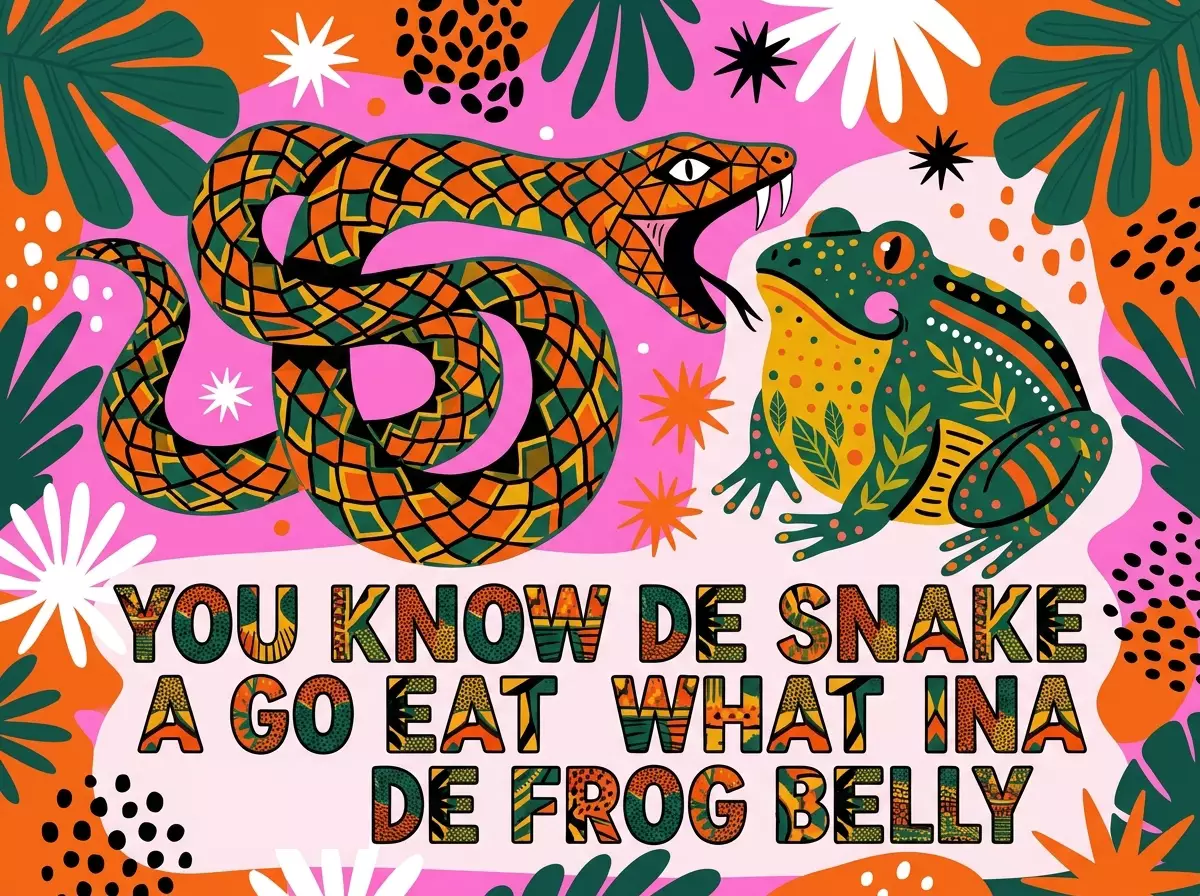
Yu nuo di sniek a go iit wat ina di frag beli.
Shango — Sankofa (1993)
05The snake and the frog
The enslaved Afrikans are the snake; the overseers are the frog. The frog appears to have the upper hand, its belly full — and is about to be eaten anyway. Shola cannot read the proverb while she is still held by her Christianization; she understands it only after joining the Secret Society and embracing Afrikan spirituality.
As victory draws near, Shango recites the proverb again — this time to a terrified overseer, at the moment the snake is about to eat the frog. Shango’s language practice makes the essay’s case: the Jamaican language is a representation of Afrikan consciousness and resilience, and Sankofa locates it squarely within its Afrikan context.
·Terms used in the paper
- Sankofa The Twi verb chain San-kɔ-fa — go back and retrieve what was left behind, in order to meet a present problem.
- Ebonics The languages of the Afrikan diaspora understood as relexified Afrikan languages — Afrikan in their grammar, whatever the source of their lexicon.
- Centered A work in which the Afrikan author shows strong cultural and historical grounding in the Afrikan experience.
- Dislocated A work whose reference points are predominantly non-Afrikan — described as lynched, or, where no Afrikan element remains, decapitated.
“You Know De Snake A Go Eat What Ina De Frog Belly”